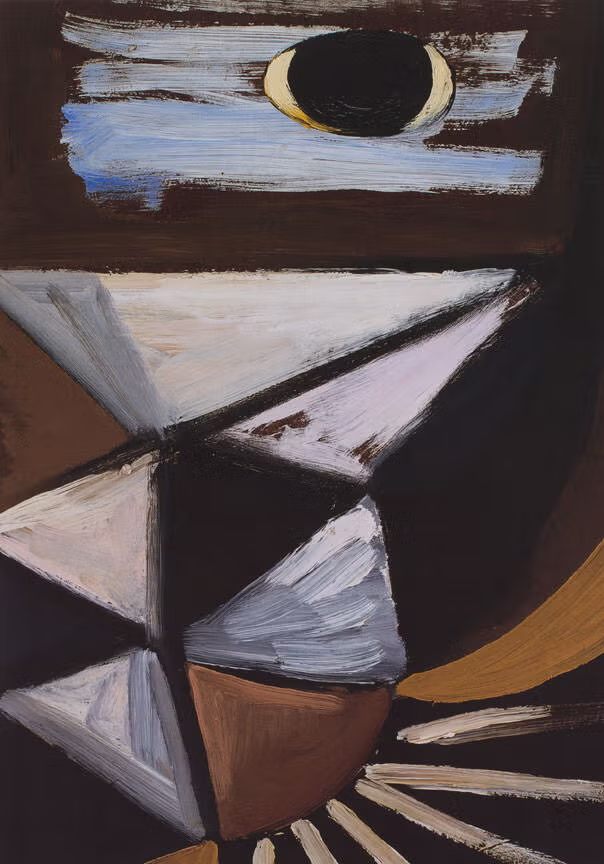
Poet Ruth Stephan and her partner, painter John Stephan, published the experimental magazine The Tiger’s Eye from October 1947 to 1949. Though they only published nine quarterly issues, the periodical showcased many influential Abstract Expressionist paintings and writings. By doing so, The Tiger’s Eye continued to position American artists, both new Americans who fled from war-torn Europe and natural-born, as serious innovators in the new post-WWII landscape.
It’s also an interesting example of the uneasy and blossoming relationship between artists, artist statements, and language around their work.
Tiger’s Eye Importance and Readership
Robert Motherwell remembered The Tiger’s Eye as “the only magazine that was a collaboration of all the artists” because both Ruth and John Stephan sought out artists’ advice and statements for publication.
Refreshingly, Ruth and John Stephan didn’t care a jot for preexisting artistic hierarchies. The Tiger’s Eye editors cast their gaze equally upon known and unknown artists, similar to Dorothy Miller. They did, however, prioritize new work. Pablo Picasso and Rufino Tamayo’s recent work featured alongside artists making their marks still known, like Mark Rothko and Anne Ryan.

New Yorkers, unsurprisingly, loved the magazine. But readers subscribed far away in Europe and Latin America, too.
Each issue of The Tiger’s Eye focused on a single medium or theme, somewhat similar to modern-day Lapham’s Quarterly. For example, in the graphic arts issue, different printing techniques were reproduced. William Blake’s methods, the namesake of the magazine, seemed to be of immediate interest.
The Tiger’s Eye was a distinct-looking magazine – even now. My modern exhibition catalogue features John Stephan’s striking tiger cover, and I got compliments on it. Each edition featured a slightly different tiger. But all of them peer out, stretched across the front and back cover, greeting readers ready for something novel and new.

A Precarious Relationship Between Art and Language
Language about art seems to have sat strangely with American Abstract Expressionists.
Artists frequently shunned attempts to grasp the purpose of their work. They thought this new abstract visual language they were creating should serve to express what it means to be human. And yet, many of the same artists also wrote at length about their work in avant-garde magazines, such as The Tiger’s Eye.
One way to sit with this strange and precarious relationship between art and language is to position language as an abstraction in itself. The Tiger’s Eye did just this.
Language is a primary abstraction that continually is being taken for granted as if it had “just growed” like Topsy or grass. Actually the dictionary is the great history of man’s belief and of the reality he has created.
Editorial Statement, The Tiger’s Eye, Number 5. Published October 20, 1948
If language is abstract, and indeed it is used to express abstract concepts and lived experiences. The etymology of a single word can take a reader through human history. A single sentence can express multitudes of worlds.
The Stephans seem to slide visual art alongside the written word; they declared, “any text on art will be handled as literature.”
But this was limited to artists’ words, not the critic’s words. They had to earn the right to be respected.
The Tiger’s Eye and Critics
The tension between an artist’s words on art and a third-party critic in the late 1940s becomes clearer in The Tiger’s Eye.

In one edition, The Tiger’s Eye states that “The critic, if he is to be respected, must prove his value as a wise observer.” And how should a critic do that? By understanding that, “art is greater than any of its talkers, and that in attacking it he is negating his reason for being.” The editors (I assume) basically say to critics, in my opinion, get with the modern times.
He must have the courage to project himself alongside the artist in new propensities, recognizing that newness is not pursued for its own sake, but that there still is something to be found.
Here is another instance of artists taking a step away from critics having complete control of public narratives. They’re invited, but they need to understand this new art and the new landscape.
Generally, The Tiger’s Eye preferred artist commentary over critics. For example, Rufino Tamayo’s paintings were accompanied by Spanish and English commentary. He deemed critical commentary irrelevant.

But The Tiger’s Eye went further than thumbing its nose at critics.
Separation of Artist and Work: What’s in a Name?
The Tiger’s Eye removed authors and artists names from their work in an interesting editorial experiment.
While the magazine technically credited contributors in the table of contents, it was located unintuitively in the middle.
Removing the name from work made readers face their own biases. William Carlos Williams, yes, that one, recalls the experience of reading The Tiger’s Eye and encountering the separation between creator and creation.
Certainly I was at first irritated not to be able to find AT ONCE who wrote what. But I quickly recognized the advantages of your arrangement.
What people resent most, of course, is that you show them up.
Everyone instinctively looks to see the name first so that they may know how to feel. If the name is all right they can relax and enjoy without danger of committing a — clumsiness, to say the least.
Without the name they would be lost. We are all a little that way. So it’s a valuable thing to be forced back on one’s self, one’s own taste — or lack of it, so to gain actual and immediate sense contacts with the work of art. How many are up to that? Damned few.
I know I’ve been guilty of doing a quick little, let’s say, quality check. I think most people are.

By removing credits, The Tiger’s Eye experiment highlights the complex dance between language, creator, and creation. I think this is part of why individual style is so highly regarded; even with the removal of language, you can recognize the creator. Which, in turn, is reflective of a society that praises individuality.
The Tiger’s Eye editors in edition two recognized the inherent power of a name juxtaposed with a work. They elucidated this by this small thought experiment.
The first use of a name is for identification. A name is, also, an adjective, made by the life and work of a person. Consider the critical approach in reading the sentence But it is vain to put wealth within the reach of hum who will not stretch out his hand to take it if it were signed by Al Capone, by Just Susan, by Karl Marx, by Chuang Tzu, or by its true author, Samuel Johnson.
The statement, whether it be an artist statement, aphorism, or fart joke, exists because a person created it. And their person, their personality, history, and whatever else we think we know, will color perceptions of the creation.
The artist who is not a self-adorist creates for the sake of creation, for the impulse to share the impact of reality or the sweep of fancy. Why should he try to build up an importance for himself? That is for the world to decide and to do.
Therefore, we use names as a recognition of merit, rather than as intellectual signatures, in The Tiger’s Eye.
So which was it? Should artists be in complete control of their narrative? Or should art be viewed for the art, and the art alone, without preconceived notions? This periodical shows an uncertainty on how to approach language, credit, and art. But also, I think, an awareness that the landscape was shifting.
Artist Reservations to Artist Statements in the 1940s
Shocking to some, but artists come in all sizes, and while some dived fully into creating artist statements, others expressed resentment.
Previously in his statement for Fifteen Americans, Mark Rothko wrote, “The progression of a painter’s work, as it travels in time from point to point, will be toward clarity: toward the elimination of all obstacles between the painter and the idea, and between the idea and the observer[…] To achieve this clarity is, inevitably, to be understood.” In The Tiger’s Eye he wrote a similar statement. Something that would fit in a contemporary gallery.
Rothko later refused to provide statements after writing statements for a Dorothy Miller American exhibition and for The Tiger’s Eye:
I have nothing to say in words which I would stand for. I am heartily ashamed of the things I have written in the past. This self-statement business has become a fad this season.
As we now know, if artist statements are a fad, it’s a very long fad.

In 1954, the famous sculptor Louise Bourgeois wrote in Design Quarterly:
The artist who discusses the so-called meaning of his work is usually describing a literary side-issue. The core of his original impulse is to be found, if at all, in the work itself.
Maybe that’s it, writing about art is an extra element to art, a Brucie-bonus as my father-in-law would say. This is a muddled and unsure period with artist statements, but that’s the point. Clearly, artists, when given the reins, such as in The Tiger’s Eye, played with language in different ways.
In the next and final post about artist statements, we’ll dive into how artist statements, which once reclaimed their work from critics and the establishment, became so commercial.