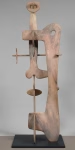
How did Dorothy Canning Miller become the head curator of MoMA in the 1940s? How did she likely shape the trajectory of artist statements and how artists present themselves well into today? If you have not heard of the name Dorothy Canning Miller, you’re not alone. (But read this previous post, it will give more context.)
Even if you’ve never heard of her, you’ve likely heard of the many artists she helped lift, including:
- Jasper Johns
- Willem de Kooning
- Morris Graves
- Jackson Pollock
- Mark Rothko
- Louise Nevelson
- and so many more

People weren’t really paying attention to artists from the United States at the time. Dorothy Miller helped change that.
Through this post, I’ll show work from The First Municipal Art Exhibition at the Rockefeller Center to show the wide range of art in one show (and because I haven’t seen them collected together). By exploring Dorothy Miller’s rebellious curatorial style and trailblazing, I’m transparently building an argument that she can be credited with the creation of the modern artist statement.
Dorothy Miller’s Background
Discerning, daring, demarked.
Dorothy Canning Miller was born in 1904 in Hopedale, Massachusetts, to Arthur Barrett Miller and Edith Almena Canning.
In 1925, she took a ten-month museum-training course at the Newark Art Museum. There, an Icelandic-American man, Holger Cahill (born Sveinn Kristján Bjarnarsson), helped teach the course. He later also served as director of the WPA Federal Art Project during the New Deal, including making post office murals a reality. Miller and Cahill eventually married in 1938, but they lived and worked together in Greenwich for many years before.
Miller always surrounded herself with art. She visited studios, fostered relationships with local artists, and became a curatorial staff member of the Newark Museum from 1926 to 1930. And from 1930 to 1932, she worked at the Montclair Art Museum, cataloging, researching, and installing collections.

The First Municipal Art Exhibition
In the aftermath of the destruction of Diego Rivera’s mural at the Rockefeller Center, a new exhibition took place: The First Municipal Art Exhibition. Sponsored by Fiorello H. La Guardia. originated by Edith Halpert, and curated by Holger Cahill and Dorothy Miller, the exhibition presented a large group of artists connected to New York. It was a beast of a show that spread its wings wide. Called a “mile of art”, Edward Alden Jewell, in The New York Times, noted: “that to take it all in at a single throw, one must be in the best of training. Three trips round the circuit are recommended.”
The exhibit included at least:
- 290 painters
- 71 sculptors
- 51 printmakers.
I’ve also seen sources record that 5,000 artists exhibited. Regardless, the exhibit was huge.

In the so-called mile, the First Municipal Art Exhibition showcased many different talents and presented well-known artists’ work side-by-side with works of lesser-known artists. This became a hallmark of a Miller-curated exhibition, intended to surprise and engage audiences with unexpected juxtapositions.
I have a tremendous passion for making a good exhibition . . . there has to be an element of drama in it, it [should] knock your eyes out.
Dorothy Miller
The First Municipal Art Exhibition Critical Response
The press took notice of the unique curatorial style:
There in the spacious, many-tiered Forum Galleries of Rockefeller Center the lions lay beside the lambs in apparent amity. It seemed hardly credible that paintings by John Marin and Arthur G. Dove could peaceably flank an oil by Harry W. Watrous, N.A., or that a Henri Burkhard be sandwiched between a W. Elmer Schofield, N.A., and a Fred Dana Marsh, N.A., but your eyes told you that it had been done, and with astonishing success.
FIRST MUNICIPAL ART EXHIBITION, NEW YORK, The American Magazine of Art, Vol. 27, No. 5 (MAY 1934), pp. 271-273
Also, it’s quietly revolutionary; by removing a visual hierarchy, the exhibition presents every artist equally, regardless of perceptions of them. Jewell noted, “Each painting, each print, each piece of sculpture found its place as a result of careful, intelligent, sometimes positively inspired deliberation.”
I couldn’t find attendance numbers, but critics expected hundreds of thousands of viewers at the Rockefeller Center. Even cops had an opinion: they did not like Thomas Hart Benton or nudes. (Shocking.) The mayor, LaGuardia, bought 20 prints.

Most agreed it was an excellent, if a rather large, exhibition. Critics highlighted the different styles coming together harmoniously and lauded the hard work, good taste, and sound aesthetic judgment of the exhibition runners. Sculpture, especially, seemed to impress.
This quote seems to capture the zeitgeist:
The fact, however, that a municipally sponsored art exhibition can exist at all may mean that we are entering the dawn of a new relationship between the artist and the people. The proper social supervision can coax this small fire to a bright flame.
Unfortunately, Cahill couldn’t see his success on opening night. A medical emergency hampered him: gall bladder removal. So Dorothy Miller stepped fully in.
Dorothy Miller’s Tenure at MoMA
Not long after the success of the First Municipal Exhibition, Dorothy Miller put on her “best summer hat” and asked Alfred H. Barr, Jr, director of MoMA, for a job.

The two had an existing relationship. As discussed in a previous post, Miller asked Barr for help diffusing the Diego Rivera mural fiasco. To her surprise, he helped. Miller also worked (often with Cahill) on MoMA’s catalogs and exhibitions, including the landmark folk art exhibition, American Folk Art: The Art of The Common Man in America, 1750-1900. She also worked on American Sources of Modern Art. Clearly, she had demonstrated an extensive knowledge of American art.
Barr hired Miller as his assistant curator. The first curator hired by MoMA. She joined a small staff of thirteen, including the switchboard operator.
The first exhibition she curated alone was New Horizons in American Art in 1936. Only two years later. By 1947, she was the curator of the museum’s collections.
Abstract Expressionism Abroad
In 1958, she championed Abstract Expressionism, the new purely American style, through a traveling exhibit, New American Painting.
It drew a record attendance at the Tate, though it infuriated many viewers. But undeniably, it heralded a new artistic direction and cultural shift. For hundreds of years, art created in the United States and its territories was shunned in Europe. Or considered derivative, copy cats of a “superior” European style.

The artists follow their countrymen’s liking for “bigness” as the canvases are huge.
– ‘Abstract Expressionism’, Western Morning News, 24 February 1959.
Almost all the pictures in it are as disturbing as they are large
– Terence Mullaly, ‘Artists Who Dispense with Visual World’, Telegraph, 25 February 1959.
In the rather colorfully titled article, ‘It’s Easy to Paint a Masterpiece: All You Have to Do is Get Plastered’, from the Glaswegian Evening Times. One reporter summed up the exhibit: Be big, have a statement and then have at it. Again, an intermingling with artist statements, Dorothy Miller, and 1950s art.
Regardless, critics seemed aware that American artists were here to stay on the artistic world stage with their enormous canvases.
Miller retired from the museum in 1969 at age 65. She’s considered America’s first curator of contemporary art. But, perhaps what she is best remembered for is her American Group Exhibitions.
American Group Exhibitions
In a previous post, Mid-Century Individualism: Birth of the Modern Artist Statement, we covered one of these “Americans” exhibitions. But from 1942 to 1963, there were actually six group exhibitions.
With each exhibition, Dorothy Miller highlighted emerging artists, even at the risk to herself and MoMA’s reputation. These gambles paid off, and the shows helped define what New York and American avant-garde art looked like.

Just a few of the artists exhibited in these exhibitions:
- 1942: Morris Graves; Helen Lundeberg; Octavio Medellín
- 1946: Arshile Gorky; Robert Motherwell; Saul Steinberg
- 1952: Jackson Pollock; Mark Rothko; Clyfford Still
- 1956: Franz Kline; Larry Rivers; Grace Hartigan
- 1959: Jasper Johns; Ellsworth Kelly; Louise Nevelson
- 1963: Ad Reinhardt; Robert Indiana; Marisol
In the Americans exhibitions, each artist had a small, separate gallery, often with walls painted in different colors to further visually separate artists. Even within a large group show, Miller highlighted each artist’s individuality. And they were cutting-edge. Even if contemporaries did not understand the shows at the time, they have since become touchstones for American Art.
“Congratulations, Dorothy, you’ve done it again, they all hate it!” – Alfred H. Barr, Jr
If Miller’s shows were not always well received or understood in the contemporary press, they have since become touchstones for artists’ careers and the trajectory of modernism in America. Many now-famous artists had their first big show at one of these exhibitions.
Dorothy Miller’s Legacy
Dorothy Miller respected artists of all shapes and sizes. From artists who never exhibited before, strange spiritualists, posh, to hard-to-manage artists. She swung between the Rockefeller boardroom and bohemian artist dens with ease. Seemingly charming everyone each step of the way.
Miller supported a diverse array of artists. Even artists who were not exhibited, such as Cy Twombly, sought her advice. Indeed, a majority of the pieces in Miller’s collection were gifts from artists.

Miller also stayed nimble, to the annoyance of some older artists she championed. As American art grew and changed, she kept up, always eager to discover new talent. And she rarely took the spotlight, preferring to shine the light on the artists themselves.
I was lucky to be alive—it was the artists who were making the incredible contributions.
– Dorothy Miller
As part of lifting artists, she stepped back from writing interpretative essays and critiques in her catalogues. She asked artists to write statements about their work. By removing herself from the creative process, Miller gave herself room to stay with artistic trends. But she also, whether planned or not, gave artists a stronger voice.

Miller helped introduce new artists and abstract expressionism to MoMA, New York, and the world. The work she chose to show impressed upon the world that a new type of art had arrived, and this time, it was distinctly American. Right down to the individualistic artist statement.
In 1985, her work was honored at the Smith College Museum of Art with the exhibition: Dorothy C. Miller: With An Eye to American Art.
When Miller died in 2003, museums gained half of her donated collection. The other half was sold at auction for an eye-watering $13,000,000.
Artist Statements
Wrapping up where I started. And where we’ll say goodbye to this trailblazer.
I can’t fully state that Dorothy Miller created the modern artist statement, though there is convincing physical evidence, and it fits in with her personal values. But she undoubtedly helped normalize and popularize artist statements in addition to singular artists and group shows. Undoubtedly, she was ahead of her time.
When I mentioned this research about Dorothy Miller to a good friend, she said, of course, a woman would be the first to give space to others, which made me laugh, but also…it makes complete sense, and there is a sociological angle that could be explored there.

And what’s more, artist statements felt radical at the time. Different from the stoic third-party institutional descriptions of artists used in the 1930s and earlier. Artist statements were succinct individual manifestos that disrupted the status quo. And yes, I’m going to take a leap, but I think these artist statements mirror the rise of the United States power on the “world stage”. But all this begs the question: how did artist statements overwhelmingly morph into gimmicky marketing pieces we are used to today?
Next up, mass media. Or at least, mid-century magazines. What happened when one magazine leaned into artist statements, then ripped away artists’ names from pieces? How did the abstract expressionists feel about this normalization of the artist statement?
Read More
- ‘There has to be drama’: MoMA’s Dorothy Miller broke boundaries as a female curator and champion of American art
- Game Changer Dorothy Miller
- IN THE REALM OF ART: FIRST MUNICIPAL ART EXHIBITION; AT ROCKEFELLER CENTER – Edward Alden Jewell
- FIRST MUNICIPAL ART EXHIBITION, NEW YORK – The American Magazine of Art
- Mama MoMA
- The New American Painting , 1959
- ART: SHE FOUND THE NEW IN AMERICAN PAINTING
- The Curse of the Bambino’s Statue