Artist statements, as a modern audience would understand them, likely first appeared in mid-century America. When I first started researching this topic, that is what every easily accessible blog post, article, and general consensus stated. But I couldn’t find many concrete examples.
In this post, I will follow this research thread starting in 1953 backwards until we find, what I will argue, unless proven otherwise, the first instances of the modern artist statement.
1950s: Artist Intake Forms and Isamu Noguchi
In 1953, the Metropolitan Museum of Art purchased an Isamu Noguchi piece for $6,000.
This piece:

We start with the Met and this article: “True to Form: 20th-Century Artist Statements from The Met Archives“
This article talks about intake forms that the Met collected upon the purchase of a new piece. It outlines the purchase of Kourous and then dives into other artists’ information forms. Standard basic information and piece information are gathered. And, importantly for us, there is a field for additional comments and personal comments about their work.
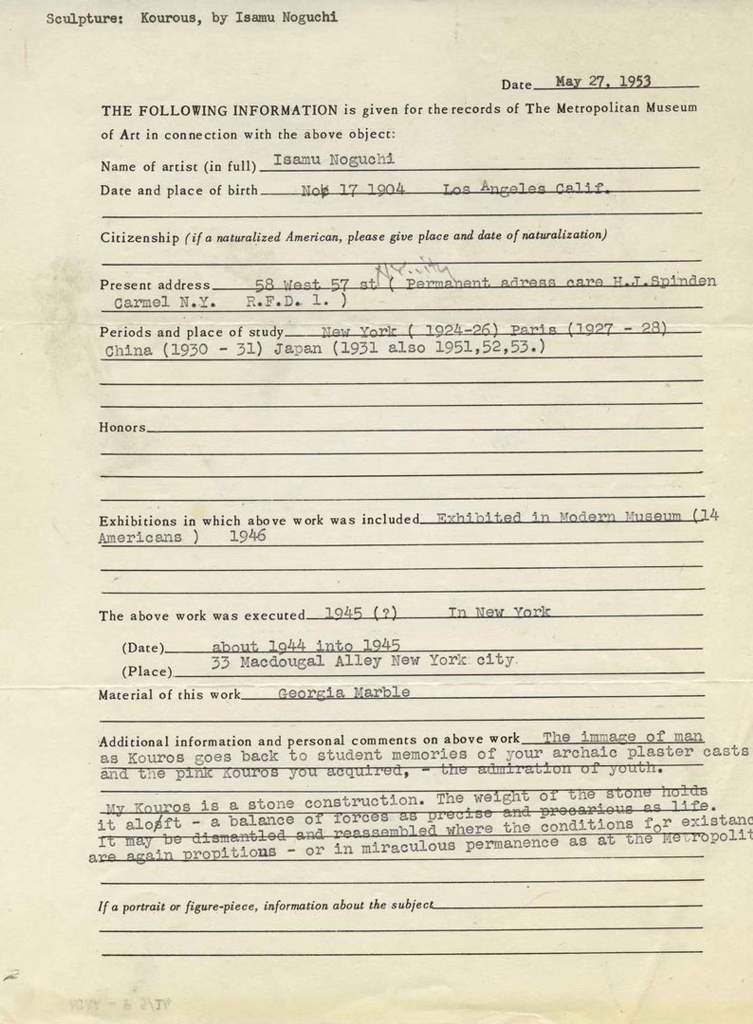
Kourous, or Kouros, as Noguchi spells it, gets extra attention in the personal comment section.
In case that scan is hard or impossible to read, Isamu Noguchi states:
“The immage [sic] of man as Kouros goes back to student memories of your archaic plaster casts and the pink Kouros you acquired, – the admiration of youth.
My Kouros is a stone construction. The weight of the stone holds it aloft – a balance of forces as precise and precarious as life. It may be dismantled and reassembled where the conditions for existance[sic] are again propitious – or in miraculous permanence as at the Metropolitan.”
This is starting to sound like a modern artist statement, even though it’s about a singular piece.
However, it’s clear and easy to follow, and even where it gets lofty, it holds firm, such as in the line: “miraculous permanence at the Metropolitan.” Imagining time forever is quite miraculous-sounding. There is also a real tenderness to this writing. It doesn’t feel like it’s written for the public to read, just the people at the Met. Indeed, “you acquired” speaks directly to the Met.
And, I find it a stretch to call these artist statements in a modern sense. They’re interesting but again, private. And really, only Noguchi seems to fit the bill. In other examples provided in the article, Charles Sheeler and David Smith also write briefly about their work. Andrew Wyeth lists galleries and museums where his work is located. Extensively. But Edward Hopper, Alexander Calder, and most of the examples in the article leave the space empty. (And yes, you can see what the Guerrilla Girls from the previous manifesto post are on about when it comes to the Met.)
The intake form practice stopped in the 1960s. The Met is unsure why.
But where, and why, did Noguchi write about his work in this style when others did not?
1946: The Fourteen Americans Exhibition
Like so many things, we have to go back further to understand. So, back to Noguchi’s piece, Kourus. Brace yourself, it’s a rabbit hole.
Kourus exhibited at Fourteen Americans in 1946 at MoMA. This exhibition platformed new and rising American artists. There were a few exhibitions like these throughout the midcentury. Robert Motherwell, I. Rice Pereira, and other influential artists joined Noguchi to make up this groundbreaking contemporary art event.
Critics liked individual pieces and artists in Fourteen Americans, but seemed generally confused by the lack of an overarching theme.
Generally, the aggregation is not a happy one — even Steinberg’s sophisticated cartoon wit is barbed and trenchant — there is much introspection, both intellectual and emotional. There are many rewarding moments but no overpowering ones.
– Jo Gibbs in Fourteen Moderns at the Modern, Art Digest, 1946
And Robert Coates in The New Yorker stated:
The result is that as one goes through the show, one finds oneself wondering what, aside from Americans, the fourteen were intended to be. It can’t be fourteen unknowns… It can’t be fourteen youngsters… I guess it must be just fourteen, period — or a case of the Museum’s having some fun playing grab bag with American art — and the outcome is a kind of basic incoherence that detracts from the ultimate effect of the show.
Noguchi exhibited a few pieces in Fourteen Americans in addition to Kourus. But I think through this piece, we can untangle the birthplace of the modern artist statement.
In the accompanying catalogue to Fourteen Artists, Noguchi writes:

Noguchi outlines his practice, his inspiration, and takes the reader into his sculptural worldview. It’s slippery and bold. Modern. It reads like a modern artist statement, just in first-person.
Which begs the question, well, who asked him to write this? It’s not an intake form comment; it’s a full statement about his work for an exhibition and what it means to him. Unlike intake forms, this is a public platform. To me, it’s an early artist statement. What’s more, all the exhibiting artists write a statement in the catalogue, not just Noguchi.
But why does this appear here and why? Who asked the question? And what question?
Fourteen Americans and the Statement of the Artist
I’m presenting this as I found things within my research. What started out as a lambast against overly pretentious artist statements became something else. In my opinion, an exploration of how intertextuality made its way into the art world.
Back to the Fourteen Americans.

What the critics seem to have missed or taken into account when searching for a broader theme is that it’s stated in the press release written by, and remember this name, Dorothy C. Miller: “It is a group of small one-man shows, each of the painters and sculptors represented with from four to twenty works in order to give an indication of individual style and direction.” It celebrates individualistic style.
But what’s more, Miller also edited the accompanying book to the exhibition, also named Fourteen Americans.
Within it, Miller explains her vision in more depth:
[The artists] are concerned not only to utter the unique and spontaneous experience of the artist, but to make that experience embody the moods and intentions of our time. […] The mood is serious, even religious, but it has nothing to do with preaching. The idiom is American but there is no hint of regionalism or chauvinistic tendency. On the contrary, there is a profound consciousness that the world of art is one world and that it contains the Orient no less than Europe and the Americas.
It’s an interesting insight into how the United States wanted to position itself after WWII. These American artists look inward to their own country and their own individuality, but position themselves globally. It’s hopeful, experimental, and worldly. I argue this is an early example of an unapologetic celebration of individualism in America. This shift, reflected even in art, heralded a new self-aware world power. Maybe that’s going too far, but it does signal a stronger confidence in American art.
Communication Above Art
Another line in the accompanying book Miller wrote I found revealing:
“These artists are concerned with communication even more than esthetics.”
In photos of the exhibition, I cannot spot any accompanying writing on the walls. But an awful lot of copies of this book can be found on eBay at lower prices (as of March 2026), suggesting that a large amount of Fourteen Americans were printed. So this is just guesswork to match this quote, but it suggests that viewers were also meant to understand the pieces and artists through the artists’ words.
Regardless, this book is where all the artists, including Noguchi, had a space to communicate with the audience about their work.
And here is why I’ve followed this thread. On the frontispiece, the artists are highlighted with this line: “statements by the artists and others.”

Statements by the artists! I would not be surprised if Noguchi learned from his writing from this exhibition in 1946. Then continued to write about his work to the point that it felt natural enough to write in this style in the Met’s intake form. Especially when none of the other artists did in the same fashion.
“We are reborn, and so in art as in nature there is growth, by which I mean change attuned to the living.” – 1946
“The weight of the stone holds it aloft – a balance of forces as precise and precarious as life.” – 1953
Generally, the consensus has been that artist statements started in the mid-century, but I did not find a concrete example. Until now. Identifying “the first” of anything is often so contentious and perhaps overrated. But I had to explore more.
MoMA Statements by the Artists
As stated, these “statements by the artists” feel and sound like a modern artist statement. That is, individual artists speaking directly to their viewers about their work, process, and beliefs. Even if “statements by the artists” is slightly different than the briefer “artist statement”. But that feels like an organic shift. (More on that in a later post.)
Luckily for me, MoMA has an incredible and easy-to-access archive. So I dug into other exhibitions at MoMA and other institutions from the 1930s to the 1940s to see if “statements by the artists” was commonly used in exhibition publications. I focused on MoMA because, one, again, the gorgeous archive. Two, MoMA pushed institutional artistic boundaries during this time, so if this was a new phenomenon, it makes sense to look to them. And three, I only have limited time to dig through documents.
Alas.
Third-Person to First-Person Switch 1930s
MoMA began highlighting living artists from across the United States as early as their second ever exhibition in 1930, Paintings by nineteen living Americans. Incredibly famous artists took part in this exhibition, such as Yasuo Kuniyoshi, Lyonel Feininger, and Georgia O’Keeffe, amongst others.
In the accompanying exhibition book, Paintings by Nineteen living Americans, Painting and Sculpture from 16 American Cities, the artists don’t write about their work. A third-party does.


There isn’t an exploration of the artist’s processes or themes. It’s demographic-focused and resume-like, even. There isn’t an indication of this artist’s interest. These are not artist statements.
One outlier, heavy hitters get to speak a bit about their work. After they’ve proved themselves. New artists in the 1930s, not so much.

In 1939, in Picasso forty years of his art, Picasso gets to “speak”. But again, this is different from an artist statement or statement by the artists. Not the least because the artist statement is generally brief.
However, the only similar phrasing of “statements by the artists” and presentation is from Dorothy C. Miller’s other exhibitions. “Statements by the artists” (or artist) appear over and over only on exhibitions she worked on.


The common thread is not even that these exhibitions are for an individual or a highly organized exhibition of a group of artists – it’s Dorothy C. Miller. So I have to ask, who is Dorothy C. Miller? Did she create the modern artist statement?
It certainly seems like one of the first examples of a modern artist statement appeared in 1942.
So if that is the when, we should spend more time examining if there is a why. In the next post, we’ll dive into how Miller came to be known through one of the biggest scandals in the art world: the destruction of Diego Rivera’s mural at the Rockefeller Center in 1934. And how that signaled, in my opinion, the future path for American art and a perfect environment for individualistic language to take off.


